
For centuries, Mount Fuji has stood at the centre of Japanese artistic imagination. Rising above clouds, lakes, forests, and distant towns, the mountain appears again and again in woodblock prints, paintings, poetry, pilgrimage traditions, and folklore. More than a landmark, Fuji became a symbol — one that carried spiritual meaning, cultural identity, and emotional atmosphere across generations of Japanese art.
Even today, many of the most enduring works of Japanese art are inseparable from the mountain itself. Whether viewed through crashing waves, morning mist, snowfall, or moonlight, Mount Fuji continues to represent something larger than landscape alone: permanence, stillness, endurance, and the quiet relationship between humanity and nature.

Title: Tagonoura, near Fuji (1897)
Artist: Kobayashi Kiyochika
Why Mount Fuji Became So Important
At 3,776 metres, Mount Fuji is Japan’s tallest mountain and one of its most recognizable natural forms. Its near-perfect volcanic silhouette made it visually distinctive long before the modern age, but its importance in Japanese culture extends far beyond appearance.
For centuries, Fuji held sacred significance within both Shinto belief and syncretic Buddhist mountain worship traditions. Pilgrimages to Mount Fuji became increasingly common during the Edo period, particularly among religious confraternities known as Fuji-kō, whose members travelled great distances to climb the mountain as an act of devotion and purification.
This spiritual significance shaped the way artists approached Fuji. Rather than treating it simply as scenery, many depicted the mountain as a silent presence — distant, immovable, and eternal amid the changing world below.
Mount Fuji and Ukiyo-e
The rise of ukiyo-e during the Edo period helped transform Mount Fuji into one of the defining subjects of Japanese visual culture.
Originally, ukiyo-e focused heavily on urban entertainment districts, kabuki actors, and scenes of everyday life. By the late 18th and early 19th centuries, however, landscape prints became increasingly popular. Improvements in woodblock printing techniques, growing domestic travel, and public fascination with famous places all contributed to this shift.
Few artists shaped this movement more profoundly than Katsushika Hokusai and Utagawa Hiroshige.
Hokusai’s Vision of Fuji
Perhaps the most famous Mount Fuji series ever created is Hokusai’s Thirty-Six Views of Mount Fuji. Rather than depicting the mountain in a single idealized form, Hokusai presented it through changing seasons, weather, occupations, and perspectives.
Title: The Great Wave off Kanagawa (1831)
Artist: Katsushika Hokusai
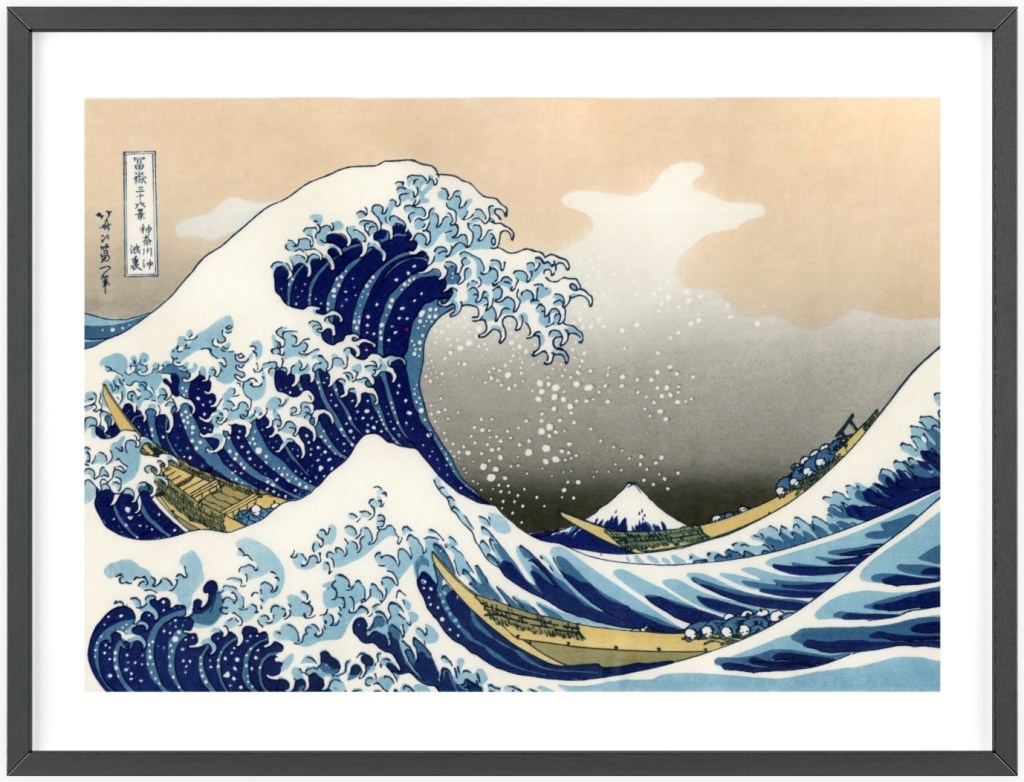
In some prints, Fuji dominates the composition. In others, it appears small and distant beyond villages, bridges, fishermen, or travellers. This shifting perspective reflected a deeper idea within Japanese aesthetics: that nature and daily life exist together, rather than separately.
Even The Great Wave off Kanagawa — now one of the most recognized artworks in the world — quietly centres Mount Fuji beneath the towering wave. The mountain remains calm and motionless while the sea churns violently around it.
Another celebrated example, Red Fuji, transforms the mountain into something almost spiritual through colour alone. Bathed in warm red light at dawn, Fuji becomes less a geographical location and more a symbol of permanence and awakening.

Title: Red Fuji (1831)
Artist: Katsushika Hokusai
Hiroshige and Atmospheric Landscape
While Hokusai often approached Fuji with bold energy and experimentation, Hiroshige became known for quieter, more atmospheric interpretations.
In Hiroshige’s Tōkaidō road scenes and his various Fuji series, Mount Fuji frequently appears through mist, snowfall, rain, or distance. Rather than overwhelming the viewer, the mountain becomes part of a larger emotional landscape.
This subtlety helped define much of later Japanese landscape art. Fuji was not merely observed; it was felt. The atmosphere surrounding the mountain became just as important as the mountain itself.
Title: The Sea off Satta in Suruga Province (1858)
Artist: Utagawa Hiroshige

Permanence and Impermanence
Japanese art often balances opposites:
- stillness and movement,
- permanence and change,
- human life and the natural world.
Fuji embodies permanence. It remains fixed while seasons, weather, and generations pass around it. In many ukiyo-e landscapes, travellers move along roads, storms gather, rivers flow, and waves crash — but Fuji remains unchanged in the distance.
This contrast reflects a deeply rooted awareness of impermanence found throughout Japanese culture and art.
Simplicity and Space
Fuji’s shape is also visually harmonious. Its clean triangular form lends itself naturally to composition, balance, and negative space. Many artists used the mountain not only as subject matter, but as an anchor within the image itself.
This quiet simplicity continues to resonate strongly in modern interiors today, particularly within Japandi and wabi-sabi inspired spaces.

Title: Mount Fuji from Momoyogusa (1909)
Artist: Kamisaka Sekka
Mount Fuji Beyond the Edo Period
The fascination with Fuji did not end with ukiyo-e.
During the shin-hanga movement of the early 20th century, artists such as Hiroaki Takahashi continued depicting the mountain through softer light, atmospheric colour, and more modern compositional techniques.
In many ways, shin-hanga artists inherited the emotional language established by Hokusai and Hiroshige while adapting it for a changing Japan.
Even contemporary Japanese design still returns repeatedly to Fuji imagery — not only because the mountain is beautiful, but because it carries centuries of cultural memory.
Title: Katsuyama Neighborhood (1929)
Artist: Hiroaki Takahashi

Why Mount Fuji Art Still Resonates Today
Part of the lasting appeal of Fuji lies in its emotional openness. The mountain can feel peaceful, solitary, hopeful, distant, or deeply contemplative depending on the artwork and the viewer.
Unlike highly narrative scenes, Fuji landscapes often create room for stillness and reflection. This may explain why they continue to feel so relevant in modern spaces increasingly shaped by minimalism, quiet interiors, and a desire for calm.
For collectors of Japanese woodblock prints, Mount Fuji also represents a connection to one of the most important artistic traditions in history — a visual language that balanced craftsmanship, atmosphere, and emotional restraint with extraordinary beauty.
At Crane & Pine, Fuji prints remain among the most enduring pieces in our collection not only because of their historical significance, but because they continue to bring a sense of calm, depth, and timelessness into contemporary interiors.
Centuries after they were first carved into woodblocks, the mountain still rises quietly through mist, waves, snowfall, and morning light — unchanged, watchful, and endlessly inspiring.
__
Crane & Pine
To learn more about Journeys Through Japan:
Leave a Reply